



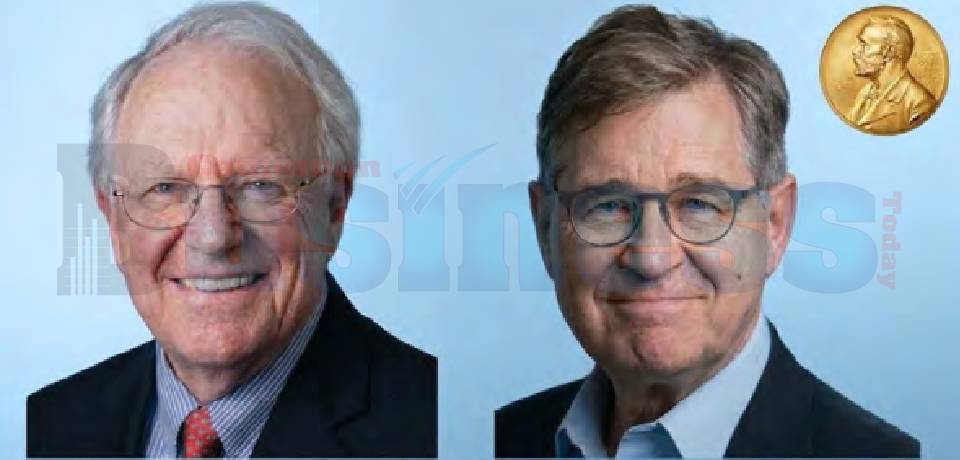
T his year’s Nobel Prize in Economic Sciences honours Robert E. Hall from Stanford Univer sity and Michael Woodford from Columbia University for decades of work developing ground-up models currently used by central banks and finance ministries across the world to stabilise economies. Rather than relying on macroe conomic models that track his torical statistical correlations, like those between inflation, output, and spending, Hall and Woodford’s approach rests on microeconomics, analysing how the choices of millions of consumers and firms shape the broader financial landscape. As per their theory, households and enterprises anticipate fu ture economic conditions when setting savings targets or pri cing goods. These expectations directly drive real-world action, clear forward guidance and enable transparent commu nication from central banks. Policymakers can then actively shape public sentiment and steer the economy toward stability. According to the 2026 lau reates, authorities shouldn’t view stabilization of the economy as an exercise that is simply conducted by people pulling levers to control the economy independently of what people in the economy understand about this. Their work shows that central banks can stimulate or suppress economic activity by adjusting interest rates, rather than by the amount of money in circulation. Accor ding to the prize award com mittee concepts like forward guidance remain core to cen tral banking today, especially after the 2008 financial crisis, when rates were near zero or even negative and standard monetary policy seemed to be out of ammunit...
This article is for subscribers only
Already subscribed? Identify yourself >
Unlimited access to Cameroon Business Today Digital from 13,250 FCFA
I subscribe1 minute is enough to subscribe to Cameroon Business Today Digital!

- Your special Cameroon Business Today issue in digital version
- Inserts
- Exclusive calls for tenders
- Preview (access 24 hours before publication)
- Editions available on all media (smartphone, tablets, PC)












Commentaires